Constraint-first AI

AI agents should target bottlenecks, not tasks.

A practical way to decide where agents belong, what they should do first, and how the advantage compounds without losing control.

Digitalverse visual showing a robotic manufacturing line and a constraint removal sequence for AI agent implementation.

AI agent implementation should not begin with a catalogue of tasks. It should begin with the operating constraint that is limiting the business.

Do not start with:

"What can we automate?"

Start with:

"What is constraining the system?"

We were recently thinking about Amdahl's Law after hearing it discussed by Peter Diamandis and the Moonshots team.

The idea is simple but powerful: improving one part of a system only improves the whole system in proportion to how much that part actually limits total performance.

You cannot outrun your bottleneck.

That connects directly with the Theory of Constraints, popularised by Eliyahu Goldratt in The Goal.

Every business system has a constraint. The constraint is the part of the operation that limits the performance of the whole.

Quoting
Customer follow-up
Scheduling
Approvals
Handoffs
Knowledge trapped inside key people

The job is to find the most constrained process, decision point, or handoff, then focus on clearing it.

Once that bottleneck is removed, the constraint moves. Then you reassess. Then you improve the next one.

The operating loop

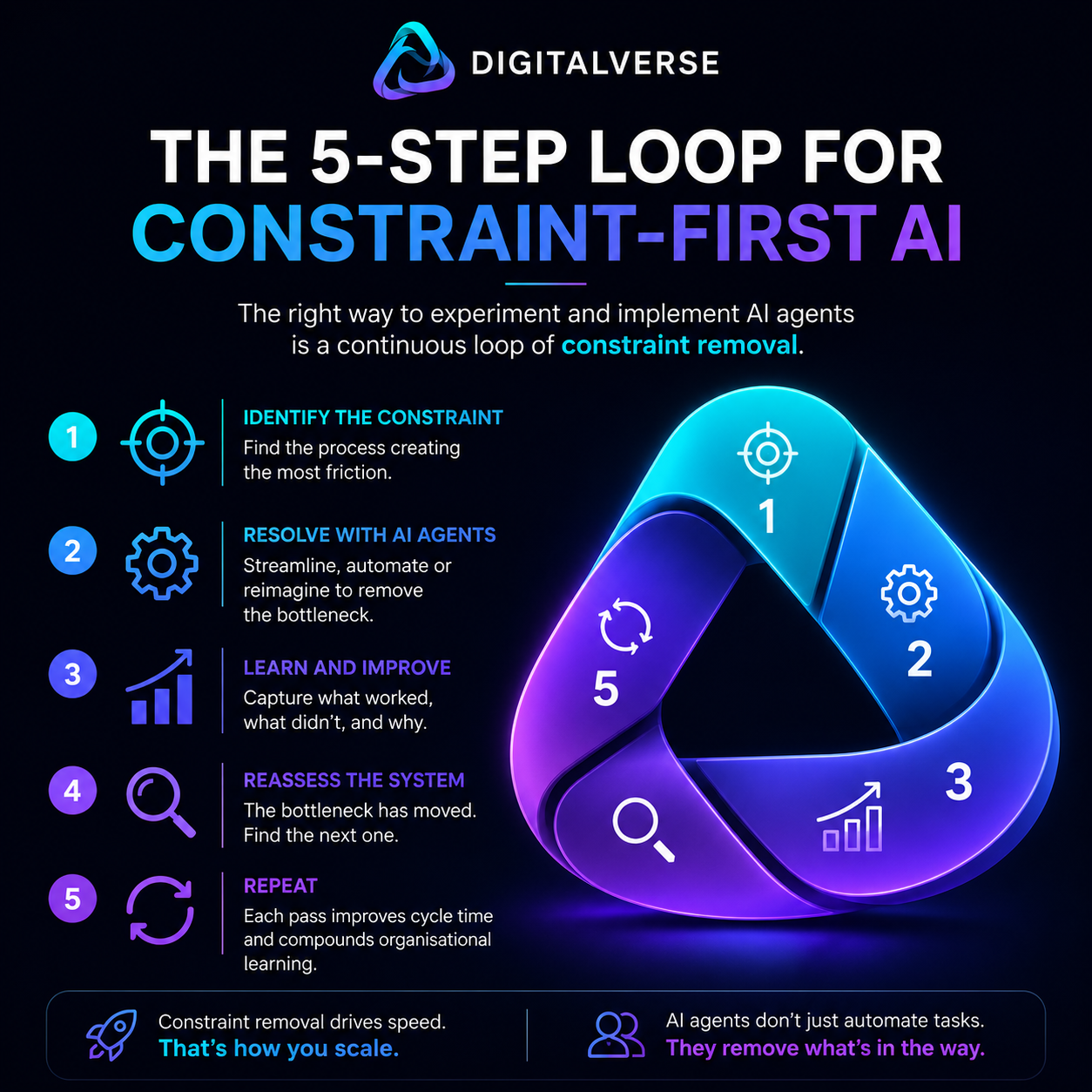
Constraint removal is the disciplined loop for agent implementation.

This is how Digitalverse believes AI agents should be introduced: not as random automation, and not as "sprinkle AI everywhere", but as a focused operating loop.

1
Find the constraint Identify the process, decision point, or handoff creating the most friction.
2
Resolve with AI agents Streamline, automate, or reimagine the work to remove the bottleneck.
3
Learn from the implementation Capture what worked, what did not, and why.
4
Reassess the system The bottleneck has moved. Find the next one.
5
Repeat Each pass improves cycle time and compounds organisational learning.
Digitalverse five-step loop for constraint-first AI: identify the constraint, resolve with AI agents, learn and improve, reassess the system, and repeat.

The real opportunity is constraint removal.

The real opportunity with AI agents is not just task automation. It is constraint removal.

Each pass improves cycle time, builds organisational learning, and makes the next implementation sharper.

But speed without control creates risk. That is why the governance layer matters: decision rights, human oversight, auditability, data boundaries, and clear controls.

AI agents can make a business faster. The real work is making sure they make the right parts faster, safely.

That is where the advantage compounds.

Find the first useful constraint to remove.

Start with the readiness check, or talk to Digitalverse about turning a real operational bottleneck into a secure managed intelligence workflow.

Check Your AI Readiness